

Researchers from Queens University Belfast and the University of Warwick have compiled the first ever collection of hit songs from seventeenth-century England, including over 100 ballads in total. In at number 32 and 44 are songs involving fascinating Plymouth Characters.
The ‘100 Ballads’ research project was led by Professor Christopher Marsh from the School of History, Anthropology, Philosophy and Politics at Queen’s and co-investigator, Dr Angela McShane from the University of Warwick. They worked in collaboration with Andy Watts and the Carnival Band, numerous invited singers from the worlds of folk and early music, and the Digital Humanities Institute, Sheffield University.
Singing popular songs of the time posed numerous dangers, as the content of certain songs could lead to severe consequences. For instance, in The Belgick Boar, a printer narrowly avoided execution, and additionally, singers faced the threat of punishment, including whipping or branding, if they were apprehended singing or selling their songs where they weren’t permitted.

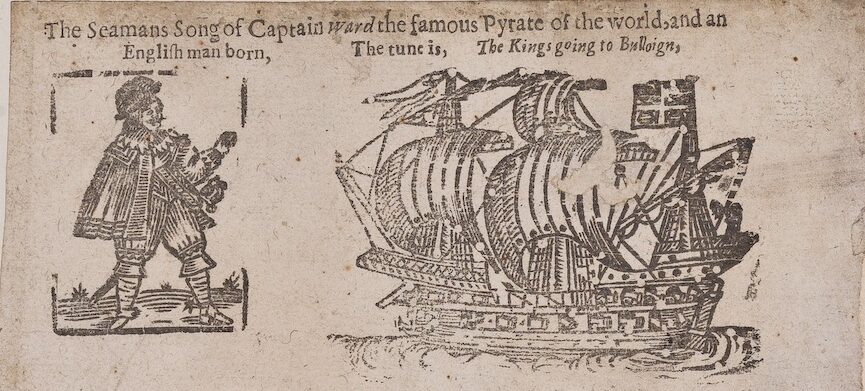
Broadside Ballads were the pop music of the Elizabethan and Stuart era. The cheapest form of literature available at the time, they sold for a penny a piece in marketplaces, and each song – printed on one side of a piece of paper – presented to the consumer a text in verse, the name of a tune and one or more simple ‘woodcut’ pictures.
Most of the ballads are anonymous, and only a few of the better-known writers were identified on the published songs.
The researchers ranked the ballads using various criteria, including the known quantity of printed editions of each ballad and the number of editions that were published within short time periods. Recordings and sheet music are available on the ‘100 Ballads’ website.
No. 32 ‘The Seamans Song of Captain Ward’ (first published around 1609)
Key facts of the song:
- This was a hit right through until the 1670s.
- John Ward was born in Kent but came to live in Plymouth in his adult life (probably around 1580)
- He was quite rough and his conversation is said to have consisted only of swear words!
- In the 1590s, he became a privateer (effectively a pirate who was allowed to operate by the government of Elizabeth I as long as he focused his activities on Spanish shipping – Spain was the great enemy of the day).
- His operations grew and grew until he formed a base in Tunis, early in the 1600s.
- Here, he grew very wealthy from his pirating and built a fine palace.
- In 1609, he converted to Islam.
- The ballad presents him as a mixture of swashbuckling hero and dangerous villain (mixed messages)
- He died of the plague in Tunis in 1622.
- Ward is said to have been the model for Johny Depp’s Jack Sparrow in the Pirates of the Caribbean films.
No. 44 ‘The Lamentation of Master Pages wife of Plimmouth’ (first published in the 1590s)
- About Eulalia Glanvill who became Eulalia Page when her parents forced her to marry a wealthy older man called Master Page.
- Eulalia was already in love with a man called George Strangwidge – so, together, they hired two local men and had Master Page murdered by strangulation.
- They were quickly caught – and they were interrogated by the famous Sir Francis Drake (three years earlier he had been one of the heroes of the battles against the Spanish Armada – he sailed out of Plymouth).
- Eulalia, George and the assassins were all convicted and hanged at Barnstaple in March 1591.
- There was also a play about Eulalia Page, staged in London later in the decade (this indicates how famous the case was)
- The ballad remained a hit for well over a century (in later editions, the publishers sometimes changed the date to make the story seem more current!)