

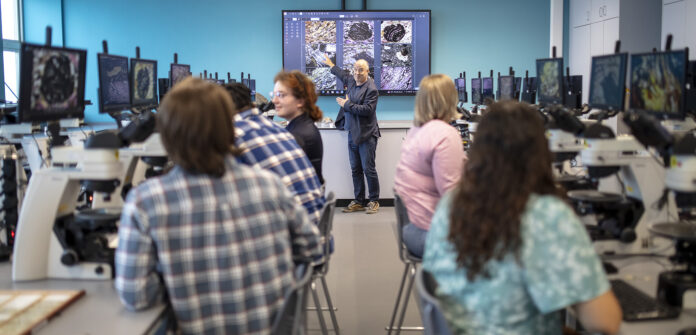
Plymouth University has become home to the first 5G microscope labs in Europe.
The facility is transforming the learning experience of students on a number of its science courses, including earth sciences, geography, environmental sciences and marine biology. The 5G microscopes are enabling students to look at a range of geological and biological samples – such as rock samples, pollen grains, microfossils and marine species – in greater detail than they would ever have been able to previously.
Students are also using the latest microscope technology to explore the fundamentals of the planet’s structures and lifeforms, and how they have changed in line with adaptations in the climate.

Comprising 150 microscopes, the labs have been created through a partnership between the University and two global technology companies, Nikon and Ostec Instruments. They also reflect recent changes to courses within the University’s School of Geography, Earth and Environmental Sciences and School of Biological and Marine Sciences that have made their content even more closely aligned with the United Nations Sustainable Development Goals.
RELATED PLYMOUTH NEWS
Plymouth University study reveals importance of shipwrecks for sea life
Professor Kevin Jones, executive dean of Science and Engineering at the University of Plymouth, said:
“These new labs will transform our teaching and revolutionise the learning experience for our students. They will get to explore a wider range of specimens in greater detail than ever before, learning the fundamentals of life on earth and how climate change is shifting the physical properties of our planet. By getting the opportunity to use cutting edge technology, our students will also gain first-hand experience of using systems that will either match – or in many cases exceed – those they will work with once they graduate.”
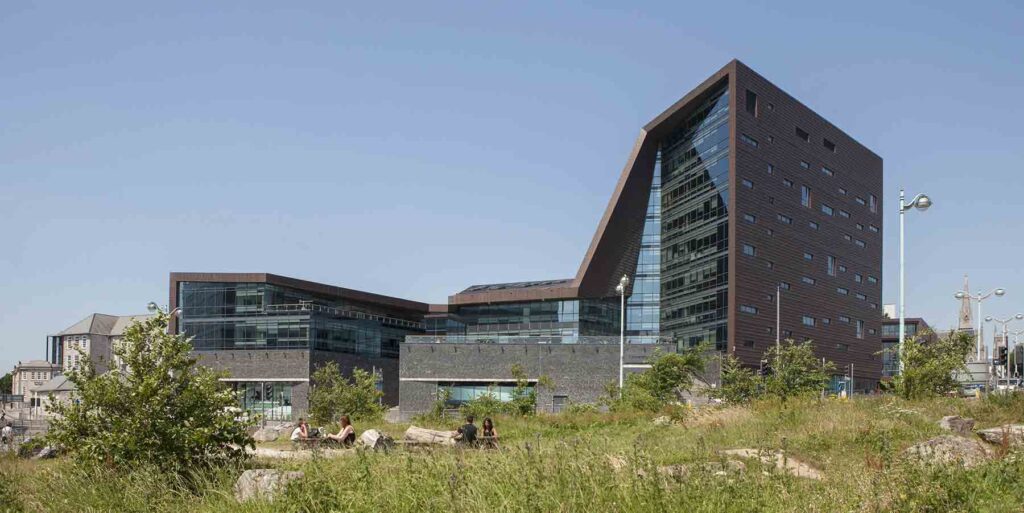
Across two spaces in the University’s Davy Building, students now have access to 60 polarising microscopes and 20 biological microscopes, as well as 60 low-power microscopes used to analyse larger specimens.
In addition to the 5G microscopes themselves, each stand has a digital screen that can be linked to others across the room so the same content can be shared across all screens.
The lecturer has their own camera set up linked to screens on each of the 5G microscope stands, and the screens also display QR codes, so that students can bring up details of what they have been looking at on their mobile devices.
The combination of microscope and screen displays, as well as desks of adjustable height, is also making the set-up more accessible to students with sight or mobility difficulties.
John Moore, European sales director for Microscopy at Nikon, said:
“Nikon Metrology pride themselves on creating smart solutions which offer universities the ability to enhance the student learning experience with quality Nikon Optics and knowhow. We are very pleased to see leading-edge Nikon microscopes being part of the first 5G interactive microscopy laboratories.”
RELATED PLYMOUTH NEWS
Key milestone for Plymouth University’s new home for engineering and design excellence