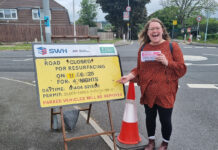

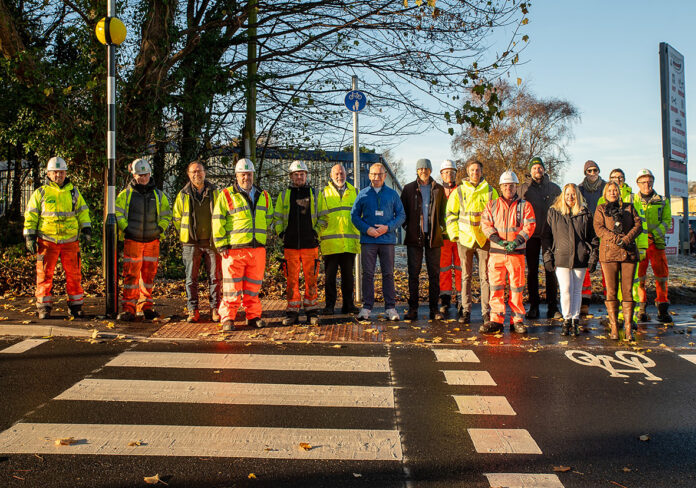
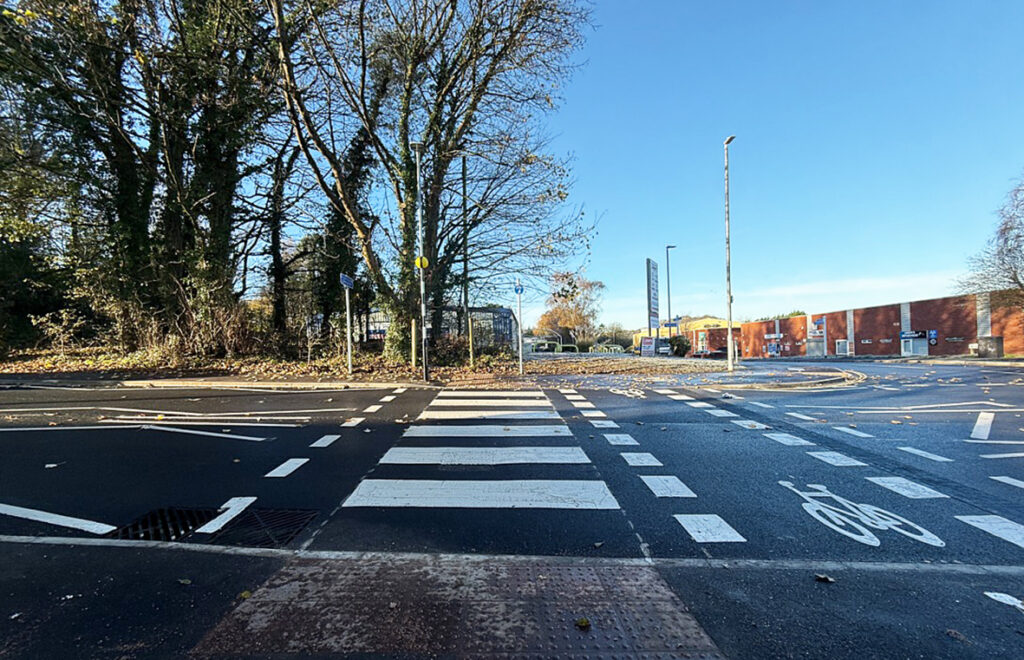
After four months of work, a new crossing point and better provision for cyclists is now in use at the Cot Hill Crossing.
The project is, however, the subject of much discussion and controversy with locals divided over its need and suitability. There are those who feel it will be underused, that the narrowing of the traffic lanes is a backward step and that the location of the Cot Hill Crossing – on a bend – is unsuitable.
Conversely there are those who feel it has already slowed down traffic speeds and that it will be much easier to cross the road, both on foot and by bike – and that they intend to use it.

Length & Cost of Cot Hill Crossing
The two things which do seem to unite most people though is concern over how long the work took to complete and its cost.
Many feel four months was far too long, but it is perhaps worth considering a bit more closely exactly what was involved. Shortly after the start of the work in mid July, preparation work revealed that there were a number of damaged drains beneath where the work was to be carried out.
Four of these drains were in Marshall Road and the fifth was in Cot Hill. To avoid subsequent excavations degrading a newly laid road surface the opportunity was taken to repair these defective drains as part of the crossing project.
Three weeks into the project work the drains had been repaired and work moved on to widening the path on the eastern side of Cot Hill to accommodate dual provision for pedestrians and cyclists. This involved completely ripping up the existing pavement.
Dropped kerbs and laying of tactile paving to assist the blind also formed part of the work as well as the laying of new kerbstones. The old wooden fence was also removed and replaced with a new one. As the pavement at this section was being widened the roadside gulley and drains also needed to be realigned.
By seven weeks into the work, the path on the eastern side of Cot Hill had been given its new surface, with tactile paving and posts for Belisha Beacons installed to mark the new crossing. The old fencing had also been replaced.
Cot Hill Crossing Works
Work then moved uphill towards Dudley Road where the existing pavement surface had to be dug out. Several parts of the carriageway showed signs of disintegration and it was discovered this was due to another broken drain, so repairing this too was added into the scope of the works.
Traffic management arrangements were altered to provide for two way rather than three way control, improving traffic flow.
By the end of October workmen had excavated and installed new kerbs on Cot Hill and Dudley Road and installed new tactiles for the new raised table crossing on Dudley Road. The remainder of the path on Cot Hill was imminently about to be resurfaced, ahead of resurfacing of the carriageway itself scheduled for week beginning Monday November 10.
Poor weather caused a slight delay in completing the resurfacing, lining and also the installation of a raised crossing table at the mouth of Dudley Road.
The cost of the work at £430,000 has raised some eyebrows and local ward councillor Terri Beer has lodged a written question with the responsible cabinet member asking for a breakdown of the costs.
Speaking before receiving Cllr Beer’s written enquiry, Councillor John Stephens, Cabinet Member for Strategic Planning and Transport, said:
“This scheme makes a really big difference for people walking between Saltram and other parts of Plympton. It also further enhances city links of the popular National Cycle Network.
“Road safety measures like this help residents walk and cycle more, which in turn improves health and wellbeing, while also reducing traffic congestion and carbon emissions.
It’s great to see the new crossing being used by those living in and travelling through the area and we’d like to thank everyone for their patience during the construction.”
Cot Hill Crossing Costs
The £430,000 project has been entirely grant-funded by National Highways through Walk Wheel Cycle Trust (formerly Sustrans), who are custodians of the National Cycle Network. It’s part of a wider £4.92 million initiative bringing improvements to the National Cycle Network across the country.
Tom Macdonald, network development manager from Walk Wheel Cycle Trust said: “The new crossing is a great example of how making changes to communities helps more people get around how they choose – be that walking, wheeling or cycling.
“Working with Plymouth City Council and National Highways the scheme has made the National Cycle Network more accessible providing the space for people to experience the joys of travelling actively every day.”
Ed Halford, National Highways Route manager, said:
“We’re committed to significantly improving safety across our road network, and the new and improved crossing will make it much easier and safer for a variety of users, including cyclists, travelling around Plympton.
“At National Highways, our work goes beyond operating, maintaining and improving roads and through our designated funding, we’re investing in the environment and communities surrounding our network, as well as the people travelling and working on it, adding real value to society.
“We’ve worked closely with Plymouth City Council and Walk Wheel Cycle Trust to realise this project – a glowing example of how this funding can make life better for communities living and working near our roads.”
(story courtesy of the Plympton Podcast)