
An appeal has been made for help in tracing the relatives of a First World War hero from Plymouth.
At the outbreak of the war Henry Eades was a 21-year-old constable with the Great Western Railway Police at Plymouth Docks in Millbay. He was one of many railway and dock policemen who resigned their posts in order to join the war effort.
PC Eades joined the 1st Battalion of the Devonshire Regiment and was later awarded the Distinguished Conduct Medal after he and another soldier single-handedly captured 250 German troops.
Now the British Transport Police History Group are looking at a project to produce a framed testament to PC Eades and present it to the Plymouth Police Station of the British Transport Police to mark Henry’s endeavours and to make a ‘then and now connection.’
Bill Rogerson, secretary of the group said:
“We are trying to trace any relatives of PC Eades, whose full name was Henry James Conway Eades. We have managed to trace a great nephew of Henry, who lives in Canada and he has told us that Henry’s family lived in the Stonehouse area at the time.
“We don’t know where Henry’s medals are, but are keen to hear from any relatives.”
Bill said that the incident which led to Henry’s recognition took place on August 22 1918 on the Somme to the south of Achiet-le-Petit in northern France when Private Eades was sent out with 35-year-old Lance Corporal George Onions to act as scouts for their company.
In the thick mist contact had been lost with the battalion on their flank. The two resourceful men located an old trench, which they found for almost its full length to be entirely unoccupied. They were planning their next move across more open ground, when a crowd of Germans appeared from nowhere and jumped into the trench.
Onions and Eades, instead of disengaging silently at once opened rapid fire with astounding results. Without returning the fire, the Germans, about 250 strong, put up their hands in surrender and Onions, forming the whole group into fours, marched them off back to their own lines and were directed to the Commanding Officer.
Bill added:
“The effect of this marching host emerging from the mist on Battalion HQ was apparently electric. Signallers and others, who had not fired a rifle in years, turned out to man trenches and a considerable amount of confusion resulted until an officer using field glasses saw the party was unarmed and headed by Lance Corporal Onions with his rifle slung, while Eades brought up the rear as a sort of whipper-in.
“The effect on the East Surreys was only a little less profound. A man was apparently sent over to ask why the Devons had taken to practising ceremonial drill on the battlefield!”
The act of remarkable gallantry by Lance Corporal Onions and Private Eades was recognised by the award of the Victoria Cross to George Onions for ‘his magnificent courage and presence of mind’, while Private Eades was awarded the Distinguished Conduct Medal (London Gazette 15 November 1918).
Shortly afterwards, having survived for most of the war, Private Eades was severely wounded and died on the 1 September 1918 at the age of 25.
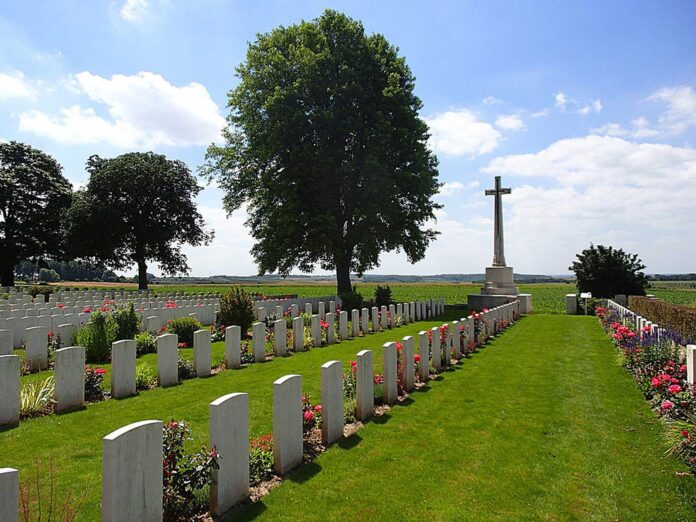
He is buried at Varennes Military Cemetery in France (Plot III, Row G, Grave 20.) He is remembered on the History Group’s Roll of Honour.
Anyone who can help with information should contact Bill Rogerson by e-mail at bill.valley@btinternet.com