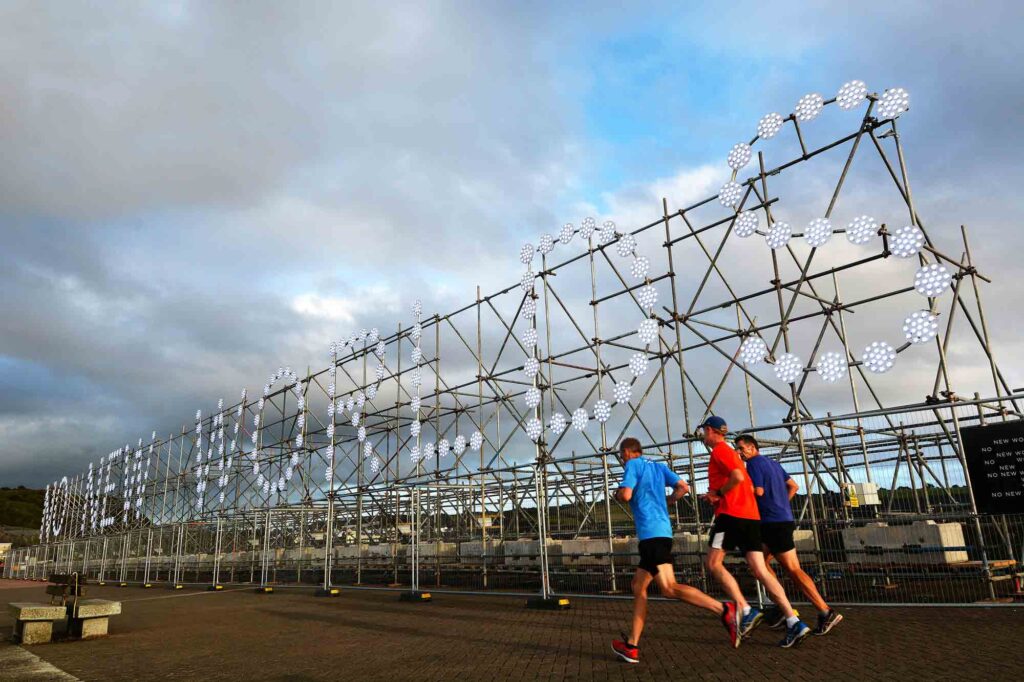


A large-scale illuminated art installation in Plymouth Sound is exploring the legacy of the voyage of the Mayflower.
Titled ’Speedwell’ the huge installation has transformed the Mount Batten Breakwater into a public forum for discussion and debate about the impact and legacy of the ship’s journey, colonialism and the ecological state of our planet during the Mayflower 400 commemorations.
Created by local artist collective Still/Moving, ‘Speedwell’ was funded by Arts Council England and Plymouth Culture as part of Mayflower 400.
Measuring 63m long and 6m high, ‘Speedwell’ uses illuminated signage comprising over 3,700 LED lights to invite viewers to ask complex questions about themselves, the damaged planet and the legacy of the pivotal journeys made by the Mayflower and its companion ship the Speedwell.
It offers multiple readings; constantly shifting between words that are lit up and questioning the historic concept that there ever was a ‘New World’. The artwork will remain illuminated through September, October and November 2020.
The installation is inspired by the events of 1620 when passengers on board the Mayflower set sail to settle in what they called the ‘New World’, a world already home to indigenous people.
Speedwell, the companion ship intended to sail alongside the Mayflower, was unable to make the journey across the Atlantic. Some of its passengers were therefore forced to return to England and find ways to make peace with the place they sought to escape.
In response, ‘Speedwell’ asks visitors to imagine new worlds of living, caring and dying well together and invites visitors to add their own voices in response to the sculpture in person or online.

Still/Moving artist, Léonie Hampton said:
“In response to the Mayflower 400 commemorative programme, Still/Moving wanted to find a way to offer audiences an open invitation to stop, think and talk about the damage in the world.
“The voyage of the Mayflower, Speedwell and what we have learnt in the 400 years since they set sail, give an opportunity to reflect and find better ways to understand the impact of those pivotal voyages and the ongoing colonial process.”
Dr Stephanie Pratt, a descendant of the Dakota (Sioux) Nation, whose guidance ensured the representation of the indigenous peoples of North America in the work said: “It is especially important to me that Speedwell’s No New Worlds installation acknowledges the presence of the indigenous peoples of North America for some 12,000 years before Europeans came to their lands.
“As one of the most visible public works this autumn, Speedwell’s illuminated messages question what it means to commemorate, and I welcome this addition to the Mayflower celebration in Plymouth.”
Adrian Vinken, chair of Mayflower 400, added:
“In exploring all aspects of the Mayflower story, and particularly its passengers being part of the intensive colonisation of America, projects like Speedwell shed light on an important and often neglected fact of history… that people with rich societies and culture had lived there as successful custodians of their natural environment for thousands of years before the Mayflower’s arrival.
“The Speedwell and other Mayflower 400 projects together aim to present a rounded picture of all aspects of the remarkable Mayflower story and its legacies.”
The installation is open to visitors to contribute their comments from 11am to 5pm daily until November 29.
For more information visit www.speedwell.live