

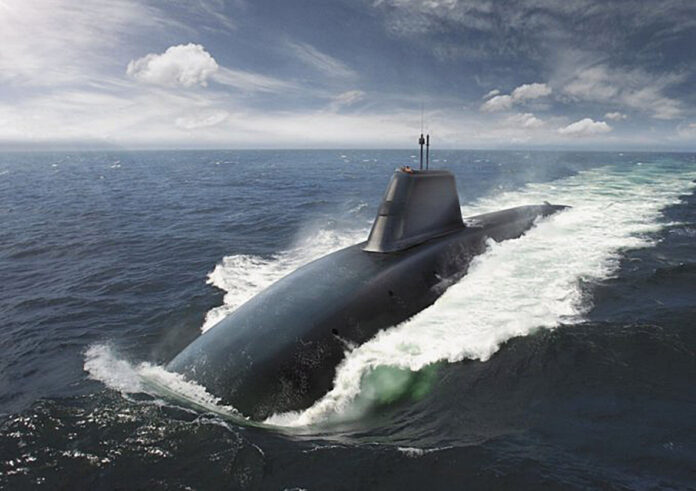
Two contracts, worth collectively over £100 million, have been awarded to Babcock to support the development of the UK’s future nuclear deterrent. The contracts will help maintain jobs across Babcock’s UK sites, including Devonport Dockyard.
The first, worth £66 million, has been awarded to Babcock to provide in-service submarine support expertise into the development of the UK’s Dreadnought Class submarines – the future of the UK’s nuclear deterrent.
Covering the next 4.5 years, the contract will see Babcock provide the Ministry of Defence with technical and management support, engineering best practice and submarine maintenance achievability.

The contract will sustain a total of 150 jobs, primarily in Bristol, but also include specialised roles across other key sites, including Devonport, Clyde, Barrow in Furness, Leicester and Warrington.

In addition, Babcock has also been awarded a £55 million contract by BAE Systems for Weapon Handling and Launch System (WHLS) and Submerged Signal Ejector equipment for boats 2 to 4 of the Dreadnought Class.
The contract will support a further 100 jobs across the UK and will see Babcock work with BAE Systems and the MOD together to ensure the Dreadnought Class is delivered on time.
READ NEXT
Babcock Devonport Site welcomes more than 250 new apprentices and graduates
The programme will support the design, development, and manufacture of the four new Dreadnought Class ballistic missile submarines – the largest submarines ever to be operated by the Royal Navy.
Ensuring the future security of the UK and its NATO Allies, the Dreadnought Class will replace the current Vanguard Class submarines in the early 2030s, maintaining the UK’s Continuous At Sea Deterrent.
Babcock chief executive David Lockwood said:
“Contributing our extensive expertise on the complex support submarines require is a hugely important aspect to the design of this new platform. By participating early in the programme, we will help to maximise the UK’s future defence capabilities.”
Minister for Defence Procurement, James Cartlidge said:
“It is undeniable the pivotal role that British industry plays in the defence of our nation and our Allies, and I’m committed to supporting UK companies who are continuing to bolster our security whilst driving prosperity across our economy.
“The Dreadnought Class will be central to keeping our country safe and will further enhance our world-renowned submarine fleet.”
READ MORE
Babcock’s major regeneration of Devonport will provide big boost for local businesses and jobs
The new Dreadnought Class submarines will be over 150 metres long, weigh 17,000 tonnes and will have a crew of 130 personnel.
In a first for a Royal Navy submarine, innovative new lighting will allow the crew to simulate night and day and it will be the first Royal Navy submarine to be built with separate female crew quarters.
Like the Vanguard Class submarines that they will be replacing in the Royal Navy’s service fleet, Dreadnought Class submarines will be capable of launching Trident 2 D5 missiles.
The new submarines will each have three missile compartments, and each compartment will comprise of four missile tubes (known as a ‘Quad Pack’) and five deck levels, for a total of 12 missiles. Dreadnought Class submarines will also feature four 533mm torpedo tubes for Spearfish heavyweight medium-range torpedoes.
They will also have modern gym facilities for the crew, including exercise bikes, rowers, weights, benches, a running machine and cross trainer.
READ MORE
Babcock and Plymouth Science Park launch advanced manufacturing lab