

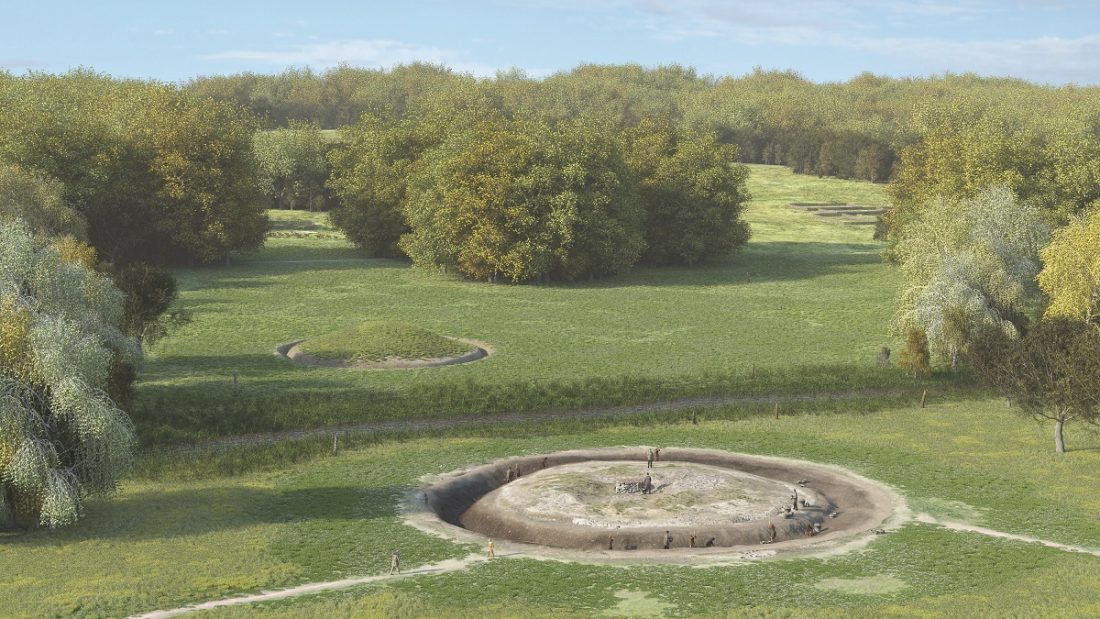
Archaeological 3D reconstructions have shed new light on the lives of ancient Bronze Age Sherford settlers, including how they lived, worked and farmed the Devon landscape.
The images, created by leading archaeology and heritage practice, Wessex Archaeology, have been reconstructed based on the artefacts and findings uncovered at the Sherford site, and include a reconstruction of a Bronze Age man, as well as an ancient landscape view of Sherford.
“It is fascinating to find out more about Sherford’s history”
The archaeological work, funded by the Sherford Consortium and carried out by Wessex Archaeology, alongside Devon County Council and consultants AECOM, has unearthed exciting discoveries that have helped to provide more information about Sherford’s history, including prehistoric pottery, Bronze Age tools, roundhouses and barrows.


Dating from 2200 BC to 800 BC, and following extensive archaeological investigations at Sherford, the images show how Bronze Age Devon settlers lived in small communities, attracted to the area due to its location and land fertility. Soil samples taken also reveal that ancient Sherford residents would have primarily farmed the land – growing crops such as wheat or barley.
Two ancient circular roundhouses were also uncovered at the town, representing the first evidence of homes occupied by Sherford families. Large pottery cooking vessels, animal bone and seeds found at the Sherford site also reveal information about the life and diet of early settlers, who would have hunted and foraged for food, while also keeping animals such as cattle, pigs, sheep and goats.
One of the first Sherford residents has also been brought ‘back to life’, with a new 3D image reconstruction detailing how a Bronze Age male would have looked at the time. The man pictured would have likely been a wealthy individual, with evidence showing that he may also have been an important person or leader within the community.
The image also outlines the typical style of clothing of the period, with men wearing leggings, cloaks and hats, while women would have generally worn longer skirts. During the Bronze Age people began to learn new technologies including weaving wool into cloth. Leather was also refined during this time and could have been used for clothing and for shoes for the first time.
Archaeological investigations have been taking place at the location of the new community development for the past three years, and have included trial trench evaluations, excavations and site wide geophysical surveys. It is expected that following examination, many of the artefacts will eventually be on public display at a local museum.
Gareth Chaffey, senior project manager at Wessex Archaeology, said:
“It’s fantastic to help bring Sherford’s extensive history to life, helping to show what life would have been like for the first settlers in Devon thousands of years ago. By using cutting edge research technologies to analyse our findings we have painted a picture of life at Sherford during the Bronze Age, giving us fascinating insight about the people who lived and worked in the area. The images have been based directly on evidence we have found at Sherford itself.”
A spokesperson from the Sherford Consortium said:
“It is fascinating to find out more about Sherford’s history, demonstrating that families have called the area ‘home’ for thousands of years. Sherford is set to be one of the largest new communities in the region, and it is vital that its history is uncovered and protected as the development progresses.
“With the first residents now living at the new town, Sherford is already a thriving community which will soon have its own unique heritage created by the people that live there. It is fantastic to be able to share these findings and encourage more people to learn more about Devon’s rich history.”