

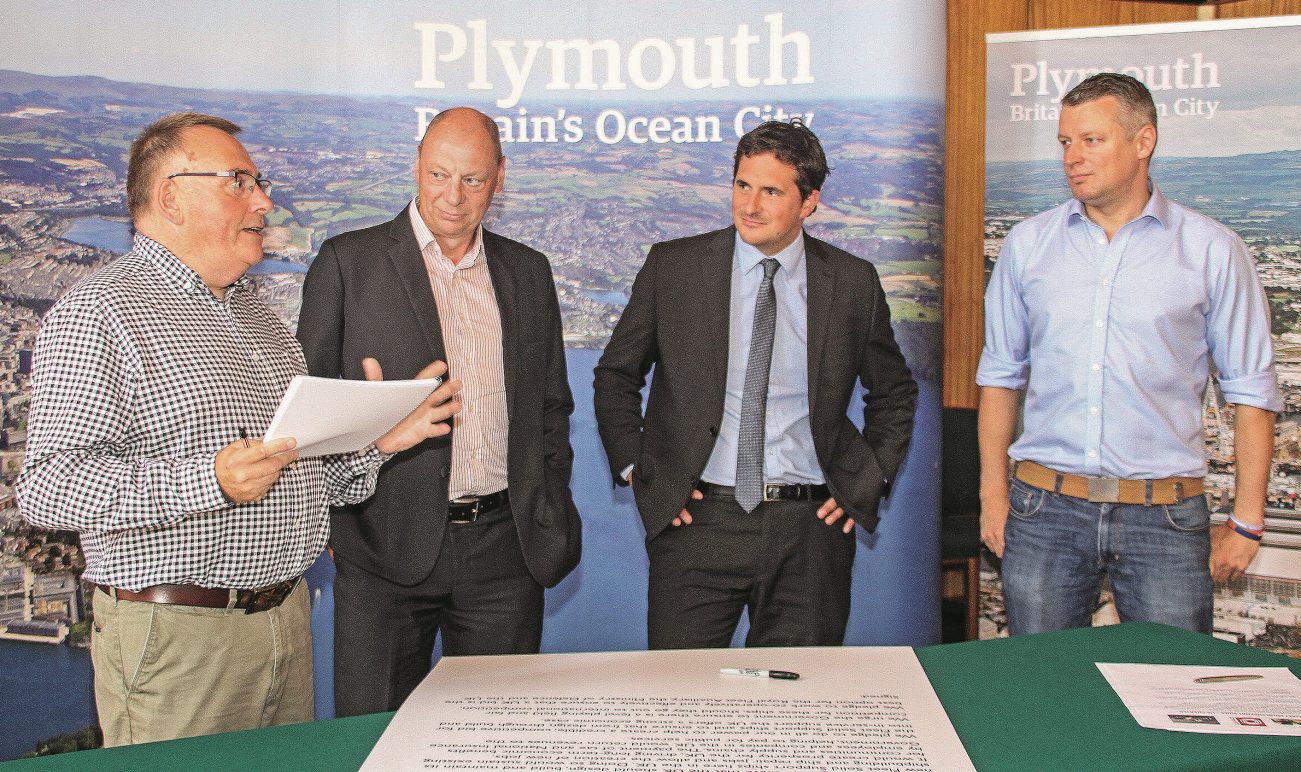
Plymouth City Council is backing a campaign to ensure a new generation of Royal Fleet Auxiliary support ships are built in the UK.
The campaign launched in the Council House in Plymouth aims to persuade the Government to protect dockyard jobs and skills by restricting bids to build the fleet Solid Support Ships (FSS) to the UK.
“This issue could have a significant impact on Devonport and other dockyards around the UK”

The campaign, which is being led by the Unite and GMB trade unions through the Confederation of Shipbuilding and Engineering Unions (CSEU), is being backed by the City Council following a motion agreed by the full Council. It is also being supported by Plymouth MPs Luke Pollard and Johnny Mercer. CSEU general secretary Ian Waddell also attended the campaign’s launch event in Plymouth.

The CSEU maintain that a total of 6,700 jobs and £285m stands to be lost under the Government’s plans, despite its claim that Brexit will strengthen British manufacturing.
The new ships, which will support the Royal Navy’s carrier strike capability by supplying vital supplies such as ammunition and spare parts, are expected to be built in time to be commissioned between 2026 and 2028 and the work will be valued at between £1 billion and £1.5 billion.
However, the National Shipbuilding Strategy (NSBS) makes it clear that the MoD does not regard these vessels in the same sense as its frigates and destroyers and plans to open the design and build up to international competition, whilst only ‘encouraging’ UK bids.

Campaigners say the new ships should be treated as warships, which are excluded from competition under EU rules, especially as no other nation competes vessels of this size and complexity.
Plymouth City Council leader Tudor Evans said:
“The council is backing this campaign because this issue could have a significant impact on Devonport and other dockyards around the UK.
“The Government must support the retention of ship design, construction and maintenance jobs and capabilities in the UK, not those in other nations who already receive state support.
“Keeping this work in the UK is important for retaining skills at Devonport and Babcock could benefit from this work if it is carried out in the UK.
“We don’t believe there is any reason why Government should not change its approach and restrict bids to the UK.“Many foreign yards are state owned or receive a significant amount of support from their governments and UK yards are at an unfair disadvantage.
“It would be a win-win if the ships are built in the UK but a massive lose if they go elsewhere.”
John Bennett, the chair of the Industrial Trade Unions at Devonport Dockyard said:
“In Germany, their government will only allow foreign bids to make the shortlist if they are at least 30% cheaper than the German bids, due to taking into account the total economic effect of sending the work abroad.
“The government needs to get its act together.”