

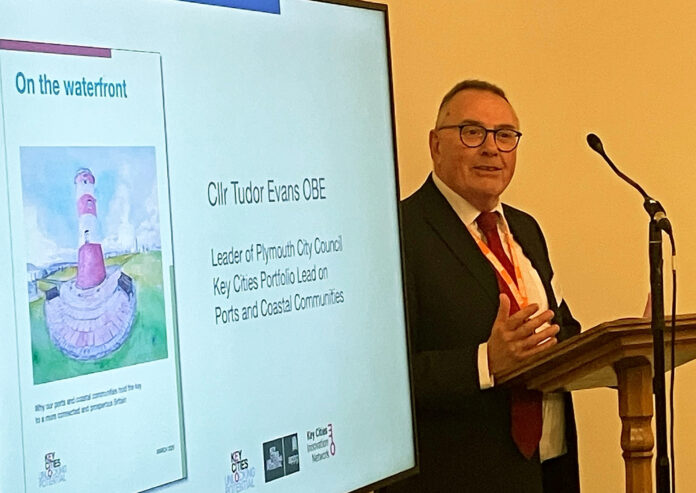
A new, major study ‘On The Waterfront’ aimed at revitalising Britain’s coastal communities has been launched at Parliament, with representatives from Plymouth playing a pivotal role in its development.
On the Waterfront is groundbreaking research and was unveiled at an All-Party Parliamentary Group meeting by Key Cities. The report underscores the immense potential of coastal communities to drive national growth and calls for urgent investment and strategic focus.
Councillor Tudor Evans, Leader of Plymouth City Council and the portfolio lead for Coastal Communities and Ports for Key Cities, opened the launch event. He said:

“This report is a game-changer and Plymouth, with its rich maritime heritage, is ready to lead the charge.
“Our coastal communities can be engines of creativity and growth, and it’s time we harness that potential. The strategies outlined in this report – focused on empowerment, protection, connection, and investment – are foundational to our success. I hope this serves as a clarion call for our new Government to act swiftly and decisively.
“As Britain’s Ocean City, Plymouth is at the forefront of this movement, ready to create a vibrant and sustainable future for all coastal communities.”
The On The Waterfront report was produced by the Key Cities Innovation Network, in collaboration with the Centre for Coastal Communities at the University of Plymouth and other universities across the country. It reveals the stark socio-economic disparities faced by traditional coastal communities across the country.
RELATED PLYMOUTH UNIVERSITY NEWS
Plymouth University’s £14.5m Refurbishment Formally Reopened
However, despite half a century of decline, these areas hold the key to economic resilience, social equity, and environmental stewardship. The message is in the report is clear; those living in coastal communities may have a different type of identity to that of the big-city dwellers, yet their livelihood remains just as important.
A look at the Cities On The Waterfront report
Economic Disparities and Employment Challenges
The report reveals that the economic gap between coastal communities and the rest of the country has widened over the past few decades. Coastal communities, once thriving with fishing, shipbuilding, and tourism, now face severe economic stagnation. In 2015, coastal economic output was already 26% below the national average, with 85% of workers earning below the UK median wage. Seasonal employment and job insecurity are widespread, with one in five coastal jobs paying below the living wage. (Page 5)
To address this, the report advocates expanding career pathways in growth industries such as renewable energy, digital services, and creative sectors, as well as targeted policies to ensure fair wages and business support.
Health Inequalities
A particularly concerning aspect of the report is the coastal health deficit, which has been well-documented by previous studies. Residents in coastal areas are 15% more likely to die prematurely from preventable illnesses, with significantly higher rates of coronary heart disease, respiratory conditions, and mental health issues. (Page 15)
Contributing factors include an ageing population, poor-quality housing (notably high levels of substandard HMOs), and fewer healthcare professionals per capita compared to inland areas. In some specialities, there are 15% fewer consultants and 7.4% fewer nurses per patient in coastal areas.
The report recommends the establishment of a national cross-government strategy for coastal health and wellbeing and innovative solutions such as mobile healthcare units and community-based services.
Infrastructure and Environmental Challenges
Many coastal communities are held back by poor transport connectivity, digital exclusion, and limited infrastructure investment. The report notes that almost half of respondents believe their region lacks sufficient National Grid connectivity to support sustainable development. Additionally, environmental risks such as flooding and coastal erosion threaten both housing stability and inward investment, with over 170,000 homes identified as at risk. (page 39)
The recommendations include prioritising 5G and Gigabit Broadband rollout, improving public transport links, and ensuring long-term investment in flood defences.
The On The Waterfront report sets out 28 recommendations under four key themes: empowerment, protection, connection, and investment. Notable proposals include:
- Creating a Cross-Departmental Task Force to coordinate national policy for coastal regions.
- Introducing targeted public funding to improve educational and job prospects in these areas.
- Reviewing government funding formulas that currently disadvantage coastal regions, such as the Green Book’s Land Value Uplift criteria.
- Supporting small and medium businesses with grants, mentorship, and enterprise zones.
Next Steps
The event was attended by city leaders, Parliamentarians, university leaders and stakeholders from across the Key Cities network, highlighting the growing ambition for the UK’s coastal communities.
This includes a host of Plymouth representatives, including Councillor Evans, along with Professor Sheena Asthana and Professor Sheela Agarwal from the University of Plymouth, along with Councillor Jemima Laing, Councillor Rebecca Smith MP and Richard Allan, Harbour Master.
The On The Waterfront report sets out 28 recommendations to empower, protect, connect, and invest in coastal communities. These include engaging with coastal communities to innovate hyperlocal public services, coordinating policy through a Cross-Departmental Task Force, and establishing long-term funding streams for strategic development
Other recommendations focus on adopting inclusive definitions of coastal communities in official statistics, and reviewing funding allocation criteria to better reflect deprivation and opportunity.
Key Cities is a dynamic network of 27 urban centres across England and Wales, including Plymouth. The Key Cities Innovation Network brings together universities to develop innovative solutions for urban and coastal challenges. This collaboration aims to promote economic growth, social equity, and environmental sustainability by advocating for policies tailored to the unique needs of these communities.