

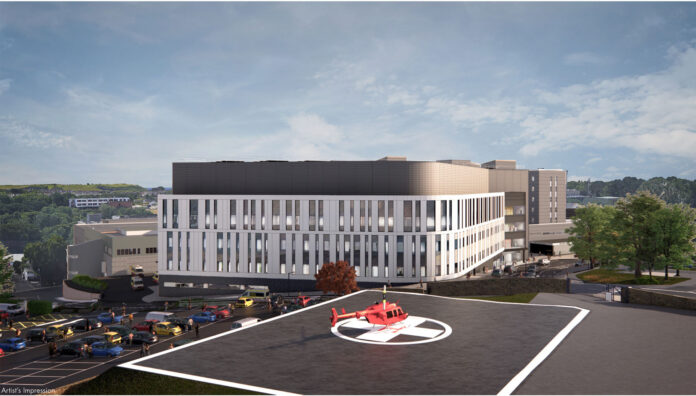
University Hospitals Plymouth NHS Trust has secured planning permission on two major developments that will see more than £140m invested in the region’s largest acute hospital.
Derriford Hospital is on a journey to redevelop its healthcare estate as part of the government’s New Hospital Programme. The focus for phase one of the ‘Future Hospital’ programme will be on improved provision for the urgent and emergency care services at Derriford Hospital.
This will involve the development of a new Urgent and Emergency Care Centre; a purpose-built facility, creating space to care for the sickest patients.

The new 165,000 sq ft build will see the co-location of the Emergency Department with urgent care pathways and the addition of dedicated interventional radiology theatre capacity (hybrid theatres which bring real-time diagnostic imaging capabilities into the operating theatre).
Enabling work is due to begin later this year with plans for construction work to start in 2023.
Future Hospital director, Stuart Windsor said: “We are delighted to announce that planning permission has been granted today by Plymouth City Council for the first phase of our development work. Our existing Emergency Department was built at a time when demand was significantly lower, so this major investment in our healthcare estate will allow us to address this fundamental challenge by doubling the amount of space for care delivery.
“It also puts us in a once-in-a-generation position to rethink the way we provide the service of the future, be that with new buildings, new digital technologies or new ways of working clinically. To do this, we have been closely working with staff and service users to focus on how we can better deliver Same-Day Emergency Care to help enable people to return home with a package of specialist care where appropriate.
“This supports better outcomes by delivering care as close to home as possible and is strategically important as we look to reduce the need for hospital admission and create a better environment to deliver our planned care services.”
The Future Hospital Programme is a long-term programme of change that will fundamentally transform how care is delivered, improving lives across Plymouth, Devon and Cornwall through investment in integrated clinical services, digital assets and estates.
The new hospital programmes in Plymouth, North Devon and Torbay will form an important part of Devon’s Long-Term Plan. The plan will make sure healthcare services in Devon are fit for the future, providing high-quality care and better health outcomes for people and their families, through every stage of life.
The planning also extends to the provision of a new woodland garden on the Derriford Hospital site. The COVID-19 pandemic has had a significant impact on patients, families and colleagues and the experience of COVID-19 has been felt in different ways for different people.
The garden will go some way to recognising the long-term impact of limited visiting and challenging work environments during the course of the pandemic. It will be a space inclusive of patients, their families, and colleagues. In addition to becoming an important space for rest and reflection, the garden will provide a gain in biodiversity on the site, providing the carbon offset for the development of the Urgent and Emergency Care Centre.
Work to start on new Royal Eye Infirmary
Meanwhile groundworks are due to start soon on the new Royal Eye Infirmary in William Prance Road. The three-floor facility will bring together the outpatient and surgical eye treatments that are currently provided at Derriford Hospital.
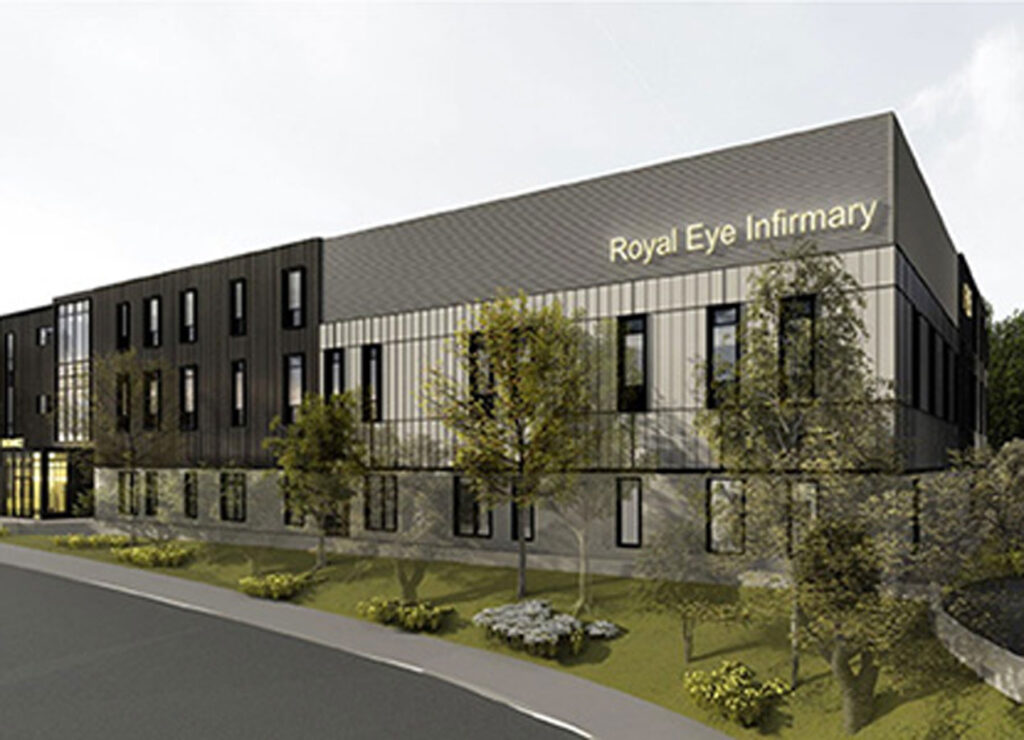
Image: DAY Architectectural
The new site offers improved access for patients with a drop-off zone and parking immediately outside of the building. The internal plans include an increased number of treatment rooms and an expanded area for young patients.
Last summer, two new modular theatres were installed at Derriford Hospital, following investment from the NHS Elective Recovery Fund to address the major impact of covid on hospital waiting times.
This dedicated capacity will be re-provided at the new site along with the addition of a third operating theatre dedicated to sub-specialisms, such as oculoplastic, orbital and corneal surgeries, to start to reduce the waiting times of patients from across Devon and Cornwall.
As a specialism, Ophthalmology (Eye Services) has a lower reliance on an acute hospital site, making it a suitable candidate for a move away from the Derriford Hospital site. However, Paediatric surgery and specialist ROP (Retinopathy of Prematurity) treatment will remain on site at Derriford.
The move will release space on Level 3 of Derriford Hospital which will be reassigned as a clinical unit and an additional ward.
To find out more about the Future Hospital programme, visit www.plymouthhospitals.nhs.uk/future-hospital