

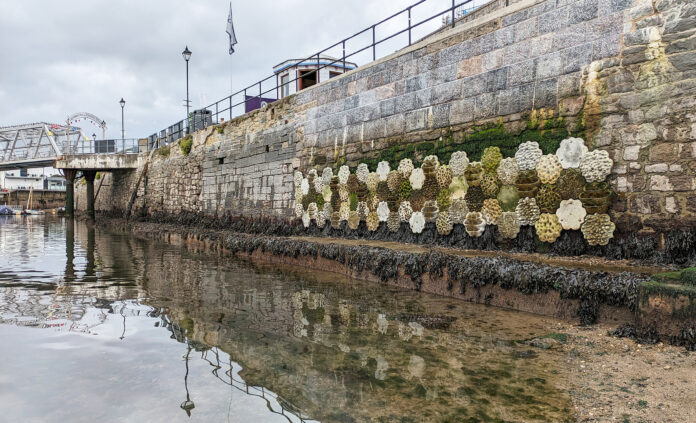
Plymouth is now home to a living seawall after organisations across the world united in an attempt to enhance biodiversity along its waterfront.
A series of specially-designed concrete panels has been installed on the edge of the Plymouth Sound National Marine Park to make new habitats available to a variety of marine flora and fauna.
The panels, developed as a result of extensive scientific research, have been fixed to the seawall close to the Mayflower Steps memorial.

They cover an area spanning 12 metres by two metres, and will be monitored over the coming months to assess any different species of flora and fauna which have taken up residence.
The hope is that they could become home to limpets, barnacles, anemones, seaweeds, sponges and other species commonly found in natural habitats along the South West coastline.
The Living Seawall in Plymouth installation is the largest of its kind in the UK to date. The project is being led by the University of Plymouth working alongside partners including Living Seawalls, Sydney Institute of Marine Science, Plymouth City Council, Tamar Estuaries Consultative Forum, Our Only World, The Rock Pool Project, Arup, Swansea University, and Ocean Conservation Trust.
The project is also being supported with funding from the University of Plymouth, Our Only World, Plymouth City Council, Tamar Estuaries Consultative Forum, Cattewater Harbour Commissioners, and Associated British Ports (ABP).
Dr Louise Firth, Associate Professor of Marine Ecology at the University of Plymouth, has worked on marine eco-engineering initiatives across the world for more than two decade and is leading the new project. She said:
“We have been investigating how to enhance biodiversity on seawalls locally for years. These efforts have all been conducted at small, experimental scales but the Living Seawall in Plymouth is the first large, real-world-scale installation in Britain. We are very excited to work with the global community to build the evidence about the ecological benefits for both new and existing artificial structures.”
The Living Seawalls initiative was first launched in Sydney, Australia, in an attempt to preserve habitats along the global coastline.

Seawall in Plymouth
were installed by the
Cattewater Harbour
Commissioners (Credit –
University of Plymouth)
Rising populations have resulted in structures such as seawalls, pilings, pontoons and marinas replacing natural habitats such as saltmarshes, beaches, mudflats and rocky shores and their associated marine life.
Research in Sydney Harbour has shown that after two years Living Seawalls already support at least 36% more species than plain, unmodified seawalls, with as many as 85 species of invertebrates, seaweeds and fish living and growing on the panels.
Professor Melanie Bishop, Co-founder of Living Seawalls, said:
“Built structures are a growing source of biodiversity loss in our harbours and coastal oceans. Living Seawalls provide a solution for returning marine life to marine constructions across the globe. We are excited to partner with the University of Plymouth on the most comprehensive trial of Living Seawalls technology in the UK yet.”