
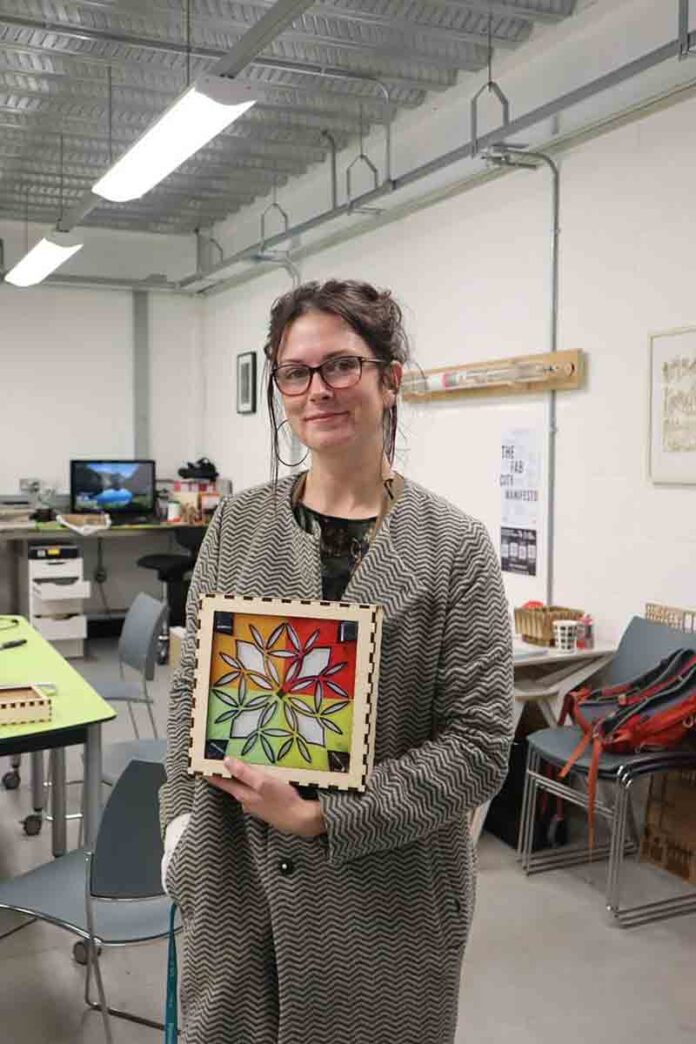
Local people have been harnessing the power of solar energy and digital technology to create their own sustainable illuminated artworks, in workshops hosted by Plymouth College of Art’s Smart Citizens Programme and South West-based art collective, Art and Energy CIC.
Fourteen local people and students attended these two-part workshops, held three months apart at Fab Lab Plymouth. During the workshops, participants learned new skills in reverse glass painting, soldering solar cells, computer aided design and laser cutting, in order to construct their unique artworks.
Charged by sunlight, these solar-powered artworks light up at night, illuminating the participants’ designs. Through creative projects, Art and Energy CIC develop artistic responses to the climate emergency, to help people engage creatively with the huge changes we experience with our energy system.

Climate emergency

Their Moths to a Flame project, co-led with Plymouth Energy Community, is working with nationwide collaborators to make 20,000 moths and record messages about the Climate Emergency to turn calls for urgent action into a magnificent mass-participation art installation at the COP26 conference in Glasgow.
In November 2020 Plymouth Energy Community and Art and Energy CIC launched a campaign with iMayflower partners Crowdfunder to hold free Moths to a Flame creative activities in Plymouth throughout 2021. Theirs was one of seven within the Plymouth Climate Challenge hosted by Plymouth City Council, with their project raising £45,189.
Workshop participant Lorraine England, a retired nurse and midwife who now works as a maker and workshop tutor, said:
“The workshops with Smart Citizens and Art and Energy really kindled an interest in solar power for me and how it can be incorporated into our lives, not just from a functional but also from an aesthetic perspective.
“Within my own creative practice I make predominantly in felt, fibre and textiles. I left Fab Lab Plymouth trying to consider how solar light could be incorporated into the illumination of artwork made from wool. Overall, I found the workshops to be fascinating, engaging, innovative and inspirational.
“During my research before and afterwards, I found many remarkable global projects where solar power has been merged with creative practice, in beautiful and functional ways such as solar trees or architecture.
“This inspired me to look into the history and principles of solar-powered systems, so that I could better understand the wiring process. This was a fascinating lesson in basic electrical circuitry and energy which I wish had been taught in science when I went to school.
“From both a societal and cultural perspective I think that the Smart Citizens Programme is timely and very relevant. Plymouth not only supports a vibrant creative community but it is one in which there are huge economic and social challenges. There is huge social deprivation and poverty in the city and an energy crisis starts to loom. With national energy costs escalating, many families are going to suffer from energy poverty. There is therefore an emergent need to make this technology more accessible to these groups of individuals, in a way that is affordable.”
Sarah Trotter also took part in the workshop. A local experimental visual artist and play and support worker, Sarah said:
“I learnt so much during the workshop and about Art and Energy’s work within communities.
“I really enjoyed learning about the Fab Lab processes and laser cutting and also how solar power cells actually work – my mind was blown and I loved the connection between the two processes! It was a truly enlightening workshop, both in terms of creativity and in gaining knowledge into how energy can be created by the sun. I was so chuffed with my completed artwork at the end of the workshop.
“The workshop has supported my knowledge around sustainability and how much of an effect it has within the world – however small a contribution, education will make a huge difference for our futures. It has made me more mindful within my own practice and something that I am looking to integrate more within the way I work and resources and materials that I use.”
Renewable energy
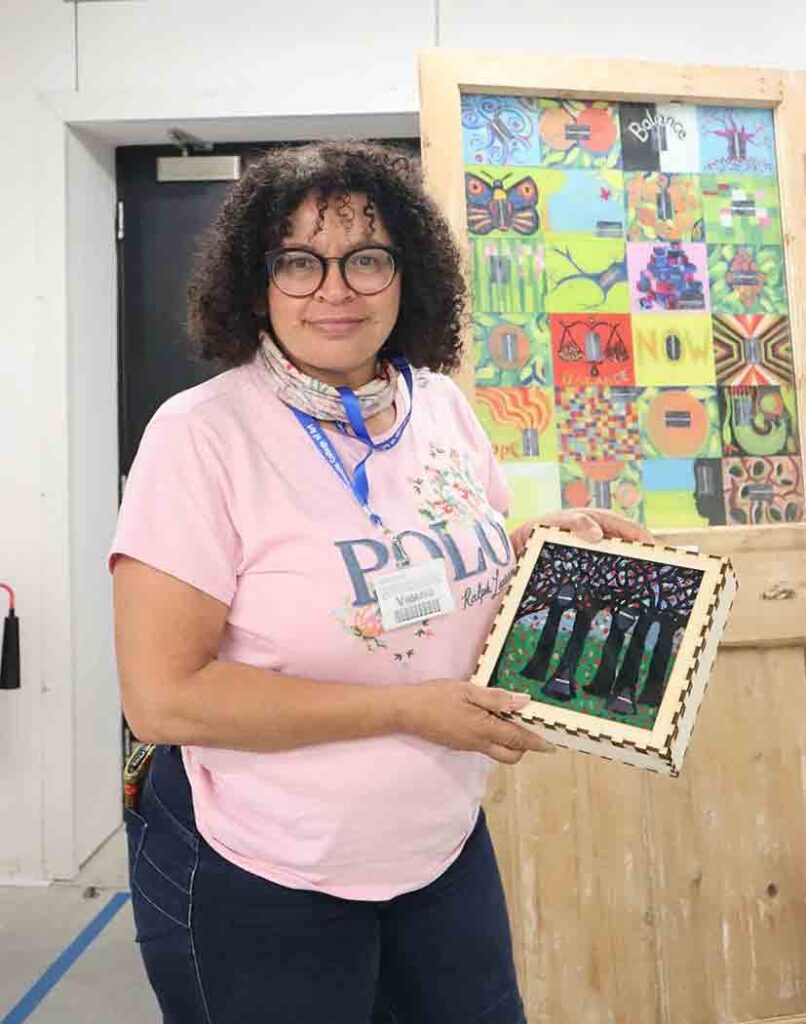
Art and Energy CIC launched in 2018 with a vision to transform the look of solar panels through art, in order to brighten up our cities, celebrate a diversity of culture and inspire more people to consider using renewable energy.
Ian Hankey, the principal technician at Fab Lab Plymouth and a master glass craftsman with extensive experience gained from the Royal College of Art, Pilkington Glass and Teign Valley Glass, worked with Art and Energy to develop a range of mark-marking processes using traditional glass processes and digital subtractive manufacturing suited to the photovoltaic panels.
These panels were tested by Dr Katie Shanks at the Environment and Sustainability Institute at the University of Exeter and now form part of Art and Energy’s ongoing work.
Jenny Ayrton, one of the directors at Art and Energy, is a Plymouth College of Art graduate and practicing artist, specialising in sand and kiln cast glass, etching and engraving.
Art and Energy CIC have benefited from collaboration with expert staff members from Plymouth College of Art, Fab Lab Plymouth and Crowdfunder as part of the Environmental Futures & Big Data Impact Lab and later the iMayflower Smart Citizens Programme.
The solar-powered art workshops are part of the iMayflower project and have been supported by The Department for Digital, Culture, Media and Sport, who fund the Cultural Development Fund, which is administered by Arts Council England.