

Campaigners who want to see a directly elected mayor in Plymouth are working hard to collect the signatures of around 10,000 electors in the city so that a referendum is triggered, allowing voters to decide.
- Campaign Launched for Directly Elected Mayor in Plymouth
The YESDEMPLYMOUTH campaign, led by Angus Forbes, aims to collect nearly 10,000 signatures to trigger a referendum, allowing residents to decide if they want a directly elected mayor instead of the current model. - Criticism of Current Governance Structure
Campaigners argue that Plymouth’s indirectly elected leader model has contributed to decades of underperformance, believing direct democracy will unlock the city’s potential. - Clear Timeline and Next Steps
If the petition garners enough valid signatures by May 2025, a referendum would be held in May 2026. Should voters approve the change, the first mayoral election would take place in October 2026. Campaign leader Angus Forbes has confirmed he will not stand as a candidate.
The group, which is not affiliated to any political party, is fronted by businessman Angus Forbes, who is the husband of Dame Darcey Bussell. The couple have lived in Plymouth for more than two years and Darcey is currently the Chair of the Board of Theatre Royal Plymouth.
Angus, who is supported by representatives from the business, arts, charitable and community sectors, said:
“I believe in Plymouth, I know we can create something exceptional here, because having been fortunate to have lived in several stunning, prosperous and remote coastal cities, I know that this success can be achieved here as well.’
“But there is a blockage, and that is the structure of city governance, the indirectly elected leader model. This failing is not a personnel issue, it is a structural one. The structure is too political, too tribal and does not serve us. It is time for Plymothians to have the choice of directly choosing the leader of their city.”
To force a referendum the campaign needs to collect a total of just under 9,900 signatures – representing five per cent of Plymouth’s electorate.
The campaign titled YESDEMPLYMOUTH was officially launched in May. In the latest advertisements, the campaign’s slogan reads ‘Sign the petition, choose your leader, transform your city’.
READ MORE ABOUT THE YESDEMPLYMOUTH CAMPAIGN
The group has created a website – www.yesplymouth.com – where residents can find more information, download petition sheets and also see details of the growing number of businesses and organisations across the city where voters can sign the petition.
Angus said that they have until the end of May 2025 to secure the required number of signatures. The petition would then be submitted to Plymouth’s Electoral Roll Officer who would have one month to validate the petition and should the petition be validated, the referendum would then be automatically triggered.
“We are confident, but not complacent about achieving our target. Assuming all goes to plan, it means the referendum would take place in May 2026 at the next local elections, and then the people of Plymouth will have the final say on which governance structure they want to have. If they vote YES, that they would like to directly elect their leader, then the election would take place in October 2026.”
Angus thanked everyone who had already signed the petition, saying that they are empowering their fellow citizens by giving them the choice of better democracy, and praised his team for their efforts.
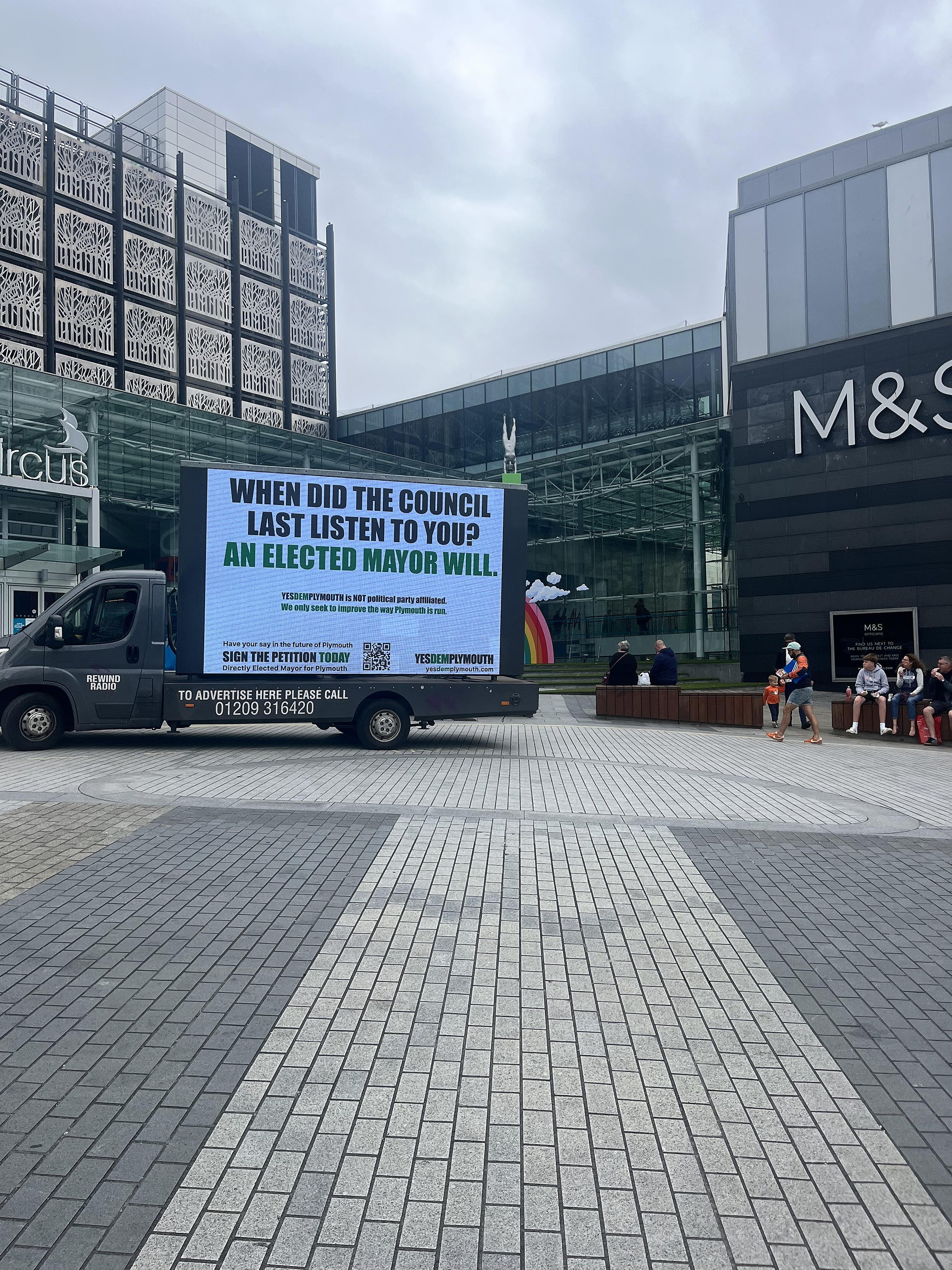
He was critical of the failure of the indirectly elected leader model to achieve the strategic targets of the last 25 years in terms of population growth, economic growth, construction of new homes, transport improvements and reduction of inter-regional wealth disparities as well as the situation with the state of the city centre, the train station and the airport.
He said that since the last referendum in 2001 – where Plymouth voted against a democratically elected mayor – the city had experienced managed decline of such magnitude, that the governance structure we use is indefensible and needs to be changed.
He pointed out that Plymouth was the worst city in England for third generation poverty, the worst for night time economy, the worst for ambulance queues, and almost the worst for business density and business start ups.
“The last 25 years have been a failure by every measure,”
he added.
“It’s time for the citizens of Plymouth to have a choice. I urge everyone who cares about the city to seek us out and sign the petition. Together let’s unblock the pathway and bear witness to achieving the real potential of Plymouth that direct democracy can bring.”
He added that if the referendum is successful he would not be standing as a candidate and the YESDEMPLYMOUTH campaign would be wound up, having achieved its primary objective of securing a successful Yes vote.